Beschreibung
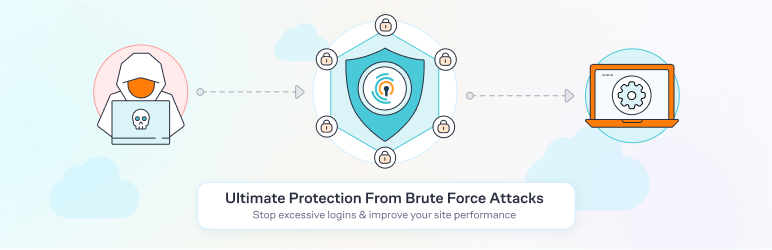
Limit login attempts, stop brute force attacks, and protect your WordPress login with one of the most trusted WordPress security plugins, used on 2 million websites.
Limit Login Attempts Security adds brute force protection, two-factor authentication (2FA), a login firewall, bot protection, and IP blocking to the most targeted page on your site: the login page. It is lightweight, works automatically with the recommended settings, and won’t slow down your website.
Why WordPress Login Security Matters
By default, WordPress allows unlimited login attempts, so bots can guess usernames and passwords until one works. With AI-powered tools, attackers can run brute force attacks faster and more effectively than ever.
Most WordPress hacks and malware infections start with a compromised login. Limit Login Attempts Security closes that door by stopping brute force attacks, bot logins, credential stuffing, XML-RPC attacks, and WooCommerce login abuse before an attacker ever gets in. For complete website security, pair it with a malware scanner. It is compatible with the popular ones.
Brute Force Protection & Limit Login Attempts
- Limit login attempts by IP address and by username
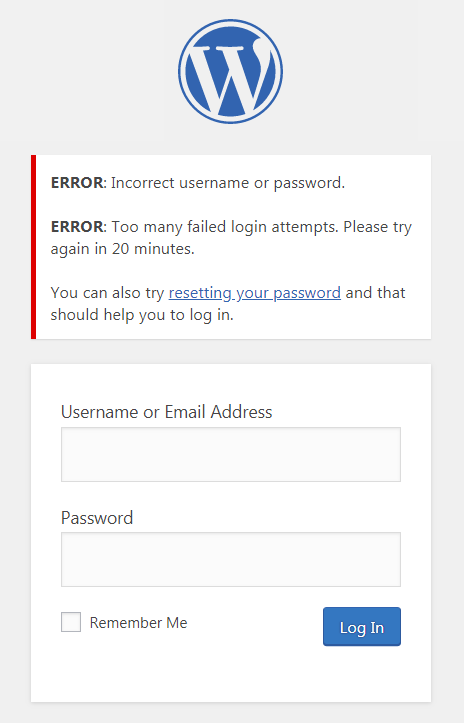
- Automatically lock out suspicious IPs and usernames
- Adjustable retry limits and lockout durations
- Protect wp-login.php and wp-admin from automated attacks
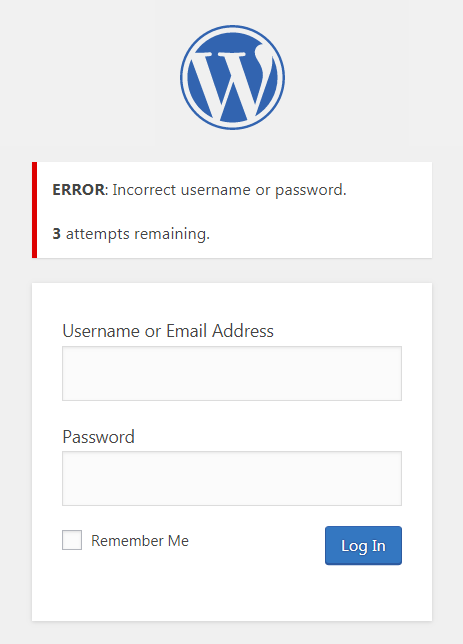
- Failed login protection with retry warnings for real users
Two-Factor Authentication (2FA / MFA)
Built-in two-factor authentication adds a second verification step to WordPress logins, so a stolen or guessed password alone isn’t enough. Secure login for administrators and users with no extra plugin required.
WordPress Firewall & Bot Protection
A lightweight login firewall that blocks malicious login requests, detects suspicious behavior, and reduces bot-based login attacks without the overhead of a full security suite.
XML-RPC Protection
Attackers use xmlrpc.php to try many passwords in a single request. XML-RPC protection applies the same login limits there, so this backdoor can’t bypass your brute force protection.
IP Blocking & Access Controls
- IP safelist and denylist (IP blocking), including IPv6 ranges
- Username safelist and denylist
- Custom trusted IP origin for Cloudflare and reverse proxy setups
Login Monitoring & Notifications
- Protokolle fehlgeschlagener Anmeldeversuche
- E-Mail-Benachrichtigungen bei Sperren
- Erfassung abgewiesener Versuche
WooCommerce, Multisite & Plugin Compatibility
Protects WooCommerce login pages, custom login forms that use standard WordPress login hooks, and WordPress multisite networks. Compatible with Wordfence, Sucuri, Ultimate Member, MemberPress, WPS Hide Login, and Cloudflare.
Premium: Cloud Login Security (Free 14-Day Trial)
Upgrade to Limit Login Attempts Security Premium to move brute force protection to the cloud:
- Real-time malicious IP intelligence and a global denylist
- Country blocking for logins
- Offload failed login traffic from your server during attacks
- Erweiterte Drosselung und Eskalation von Sperren
- Registration page protection and successful login tracking
- Lockout analytics with geolocation data
- Synchronized lockouts, safelists, and denylists across all your sites
- Cloud backups of IP data and CSV exports
- Unlock yourself from the cloud dashboard
- Priority support from security specialists
Lightweight WordPress Security
Unlike large security suites, Limit Login Attempts Security focuses on login security and brute force protection. That means faster performance, less server overhead, and easier setup, whether you run a blog, a WooCommerce store, a membership site, an agency, or an enterprise WordPress network.
Upgrade vom ursprünglichen Plugin „Limit Login Attempts“?
- Entferne das alte „Limit Login Attempts“-Plugin
- Limit Login Attempts Security installieren
- Your settings remain intact
Translations
Available in Spanish, French, German, Dutch, Turkish, Swedish, Russian, Romanian, Chinese (Traditional), Brazilian Portuguese, and more.
Screenshots
FAQ
How does limiting login attempts stop brute force attacks?
A brute force attack tries thousands of password combinations. Once an IP or username exceeds the allowed number of failed logins, it is locked out, which makes guessing a password impractical. Learn more about how to prevent brute force attacks.
Does it include two-factor authentication (2FA)?
Yes. Two-factor authentication (2FA/MFA) is built into the free version and adds a second verification step to the WordPress login.
Is this a WordPress firewall?
It is a login-focused firewall. It blocks malicious login requests, bots, and denylisted IPs at the login page. Premium adds cloud-based IP intelligence and country blocking.
Does it protect against malware and hacks?
It does not scan files for malware. It prevents the most common way sites get hacked and infected, which is a compromised login. For full website security, use it alongside a malware scanner. It is compatible with Wordfence and Sucuri.
Welche URLs werden angegriffen und geschützt?
Your login page (wp-login.php, wp-admin), xmlrpc.php, the WooCommerce login page, and any custom login page that uses standard WordPress login hooks.
Will it slow down my website?
No. It focuses only on login protection, which keeps it lightweight. With Premium, failed login traffic is handled in the cloud, which reduces server load during attacks.
Is it compatible with Wordfence and other security plugins?
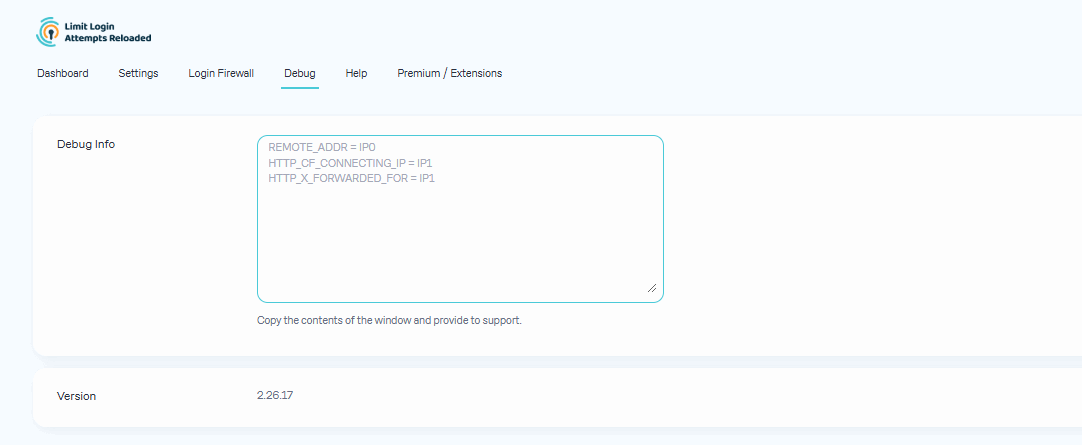
Yes. It works alongside Wordfence, Sucuri, WPS Hide Login, Ultimate Member, MemberPress, and Cloudflare. The Debug tab includes a compatibility table for popular plugins.
Was soll ich tun, wenn alle Benutzer gesperrt sind?
Your site likely sits behind a proxy such as Cloudflare, Sucuri, or Nginx that replaces visitors‘ IPs with its own, so every visitor appears to have the same IP. Adjust the Trusted IP Origin setting, or use our Cloud App, which detects non-standard IP origins automatically.
What do I do when an admin gets blocked?
Open the site from another IP, for example on your phone’s cellular connection or a VPN. If that doesn’t work, use FTP or your hosting file manager to rename the wp-content/plugins/limit-login-attempts-reloaded folder, log in, rename it back, and safelist your IP. Premium users can unlock themselves from the cloud dashboard.
Woher weiß ich, ob ich angegriffen werde?
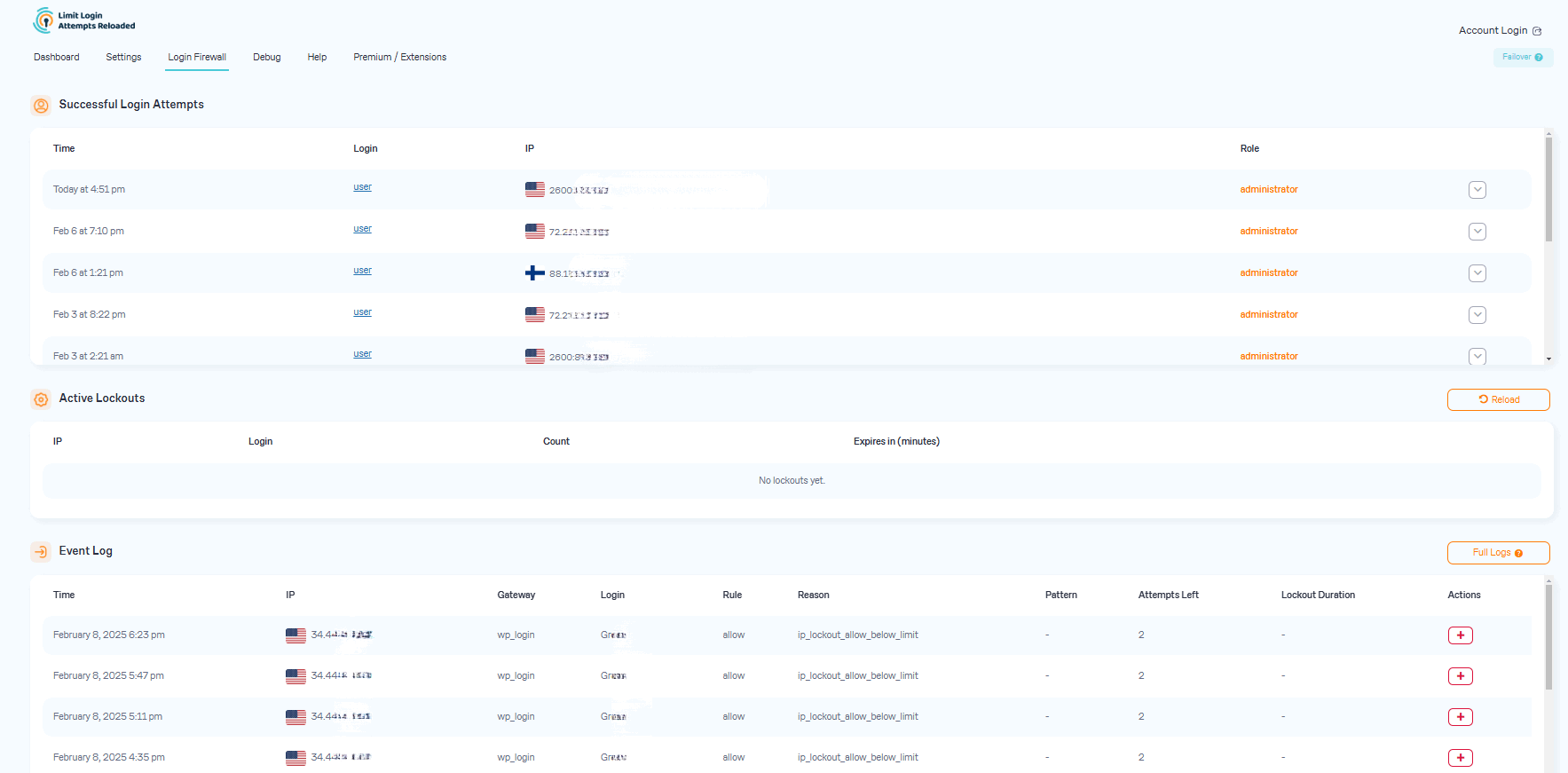
Copy the IP from a lockout notification and check its location with an IP lookup tool. Several failed logins from locations you don’t recognize indicate an attack. Dozens or hundreds of IPs per day is common.
Könnten diese fehlgeschlagenen Anmeldeversuche gefälscht sein?
No. The plugin doesn’t generate them. New sites are often on shared IPs and newly registered domains are crawled quickly, which makes them easy targets. Read more about fake login attempts in WordPress.
What settings should I use?
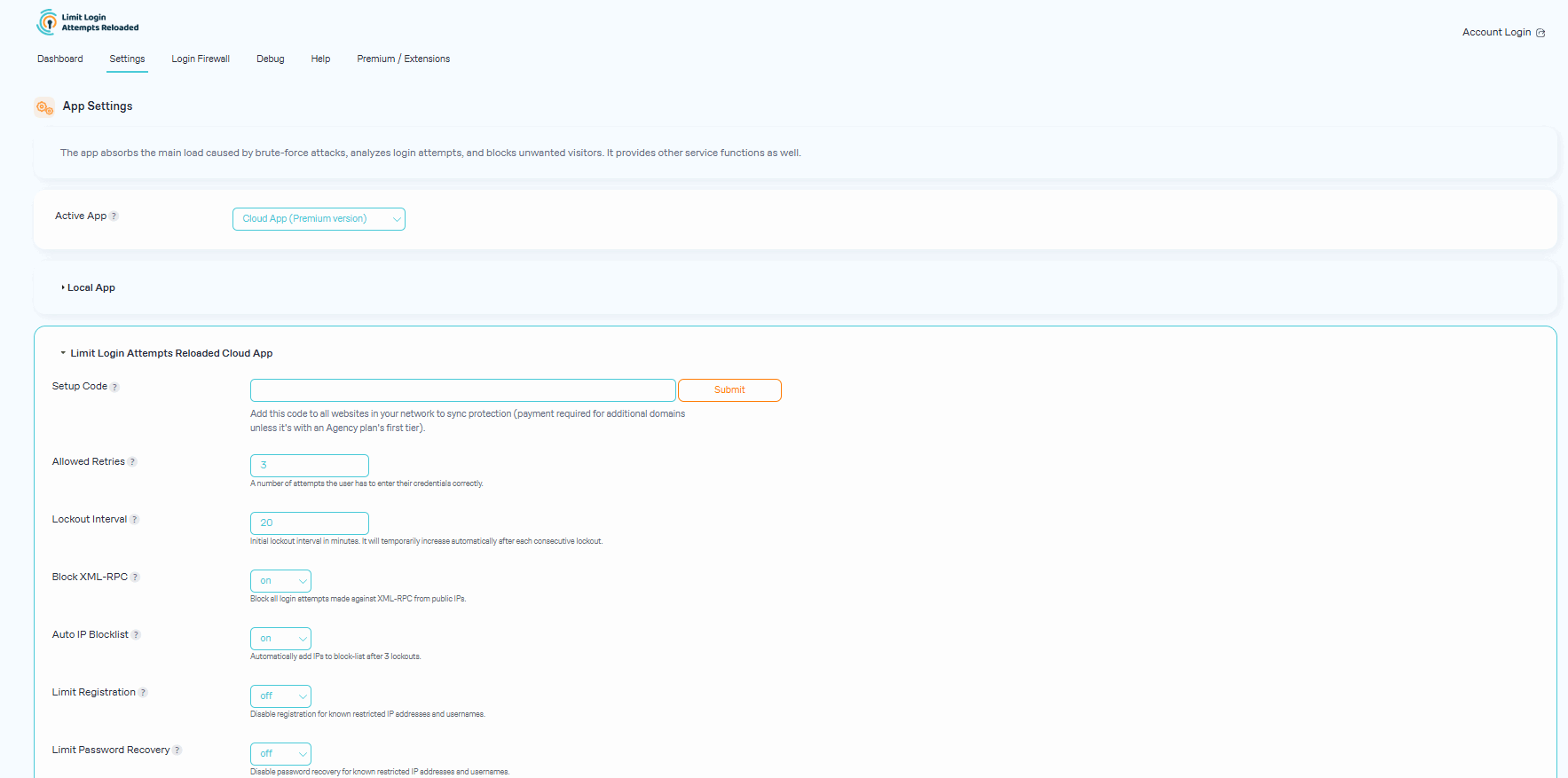
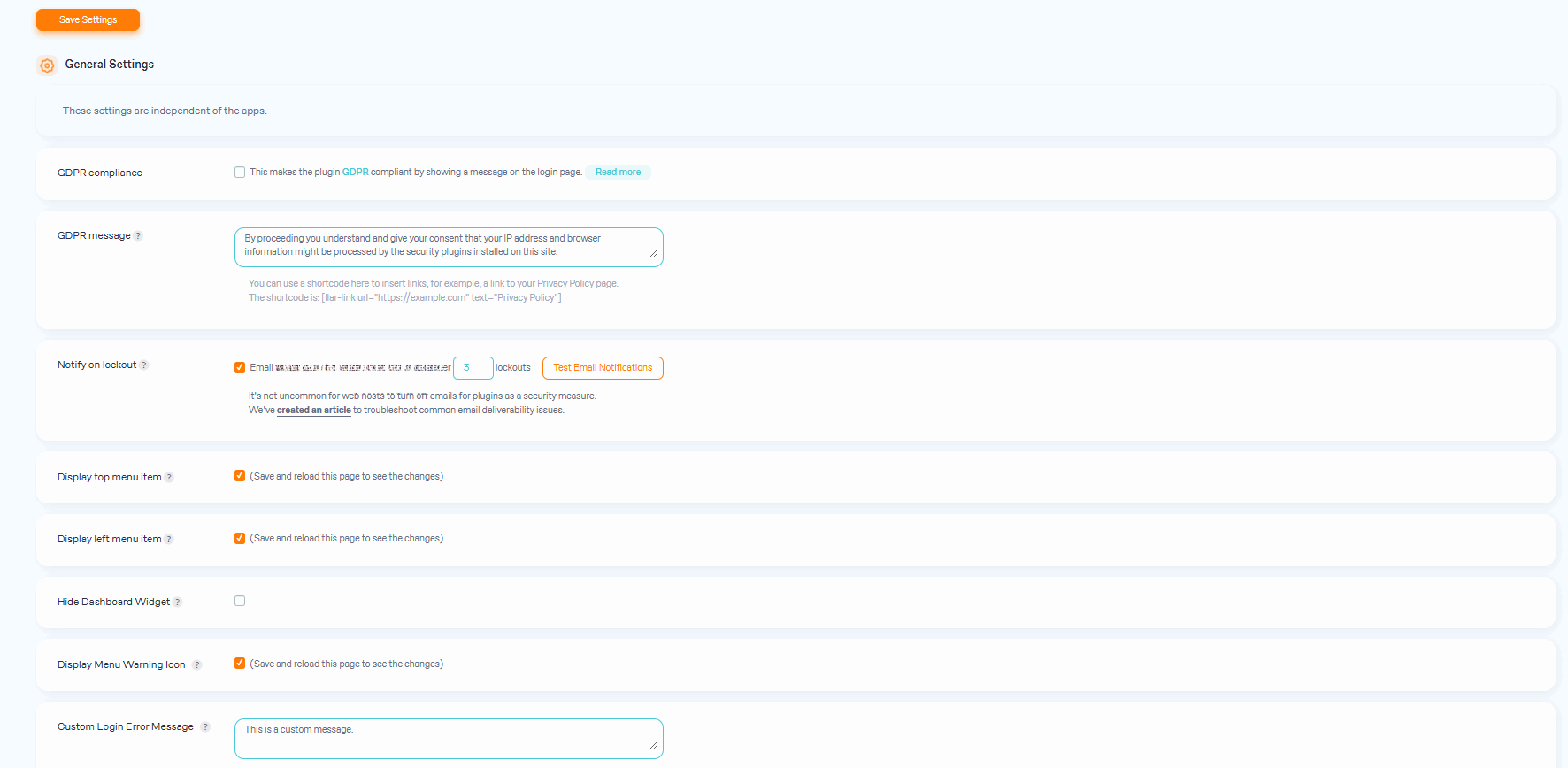
The default settings are recommended. Each setting is explained in detail within the plugin.
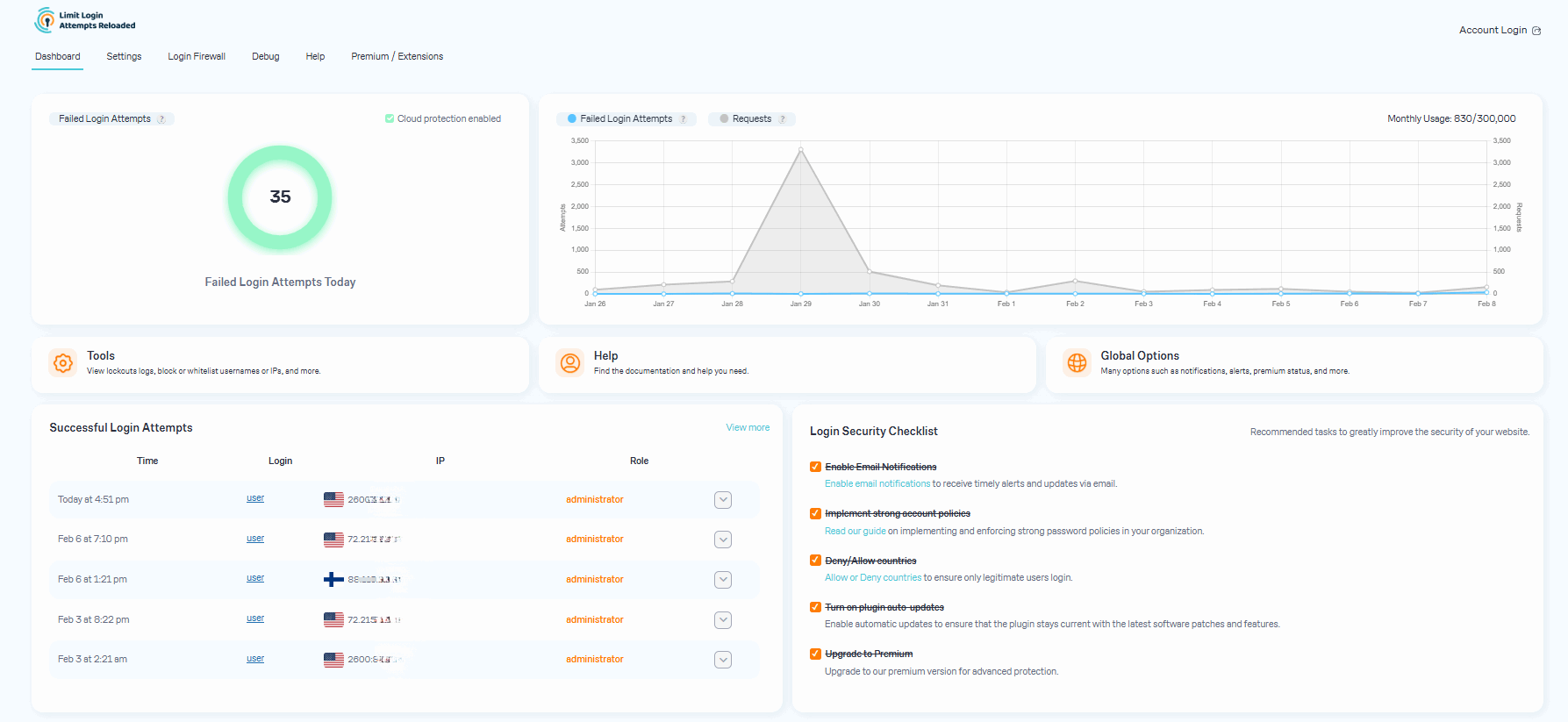
A new dashboard in your WordPress admin shows requests and failed login attempts relayed through our cloud service. You may also notice fewer lockout emails and better site performance.
Was passiert, wenn meine Website die im Plan festgelegten Anfragelimits überschreitet?
Premium plans start at 100,000 requests per month, enough for almost any heavy brute force attack. We’ll alert you if you approach your limit and suggest the next plan. On the free version, attack traffic is absorbed by your hosting, which could raise hosting costs.
On the free version, copy the lists to each site manually. With Premium, sites in the same cloud account can share lockouts and access lists.
Rezensionen


Mitwirkende und Entwickler
„Limit Login Attempts Security – Brute Force Protection, 2FA, Firewall & Login Security“ ist Open-Source-Software. Folgende Menschen haben an diesem Plugin mitgewirkt:
Mitwirkende

„Limit Login Attempts Security – Brute Force Protection, 2FA, Firewall & Login Security“ wurde in 38 Sprachen übersetzt. Danke an die Übersetzer für ihre Mitwirkung.
Interessiert an der Entwicklung?
Durchstöbere den Code, sieh dir das SVN-Repository an oder abonniere das Entwicklungsprotokoll per RSS.
Änderungsprotokoll
3.4.2
- Security: blocked a server-side request forgery (SSRF) in the app setup feature. The setup destination is validated before fetching, and redirects are checked again. Thanks to Viktor Heiduck for the report.
3.4.1
- Two-factor authentication now applies to XML-RPC logins as well as the login form. Thanks to Qi Qin for the report.
- An invalid X-Forwarded-For header no longer stops the two-factor check. Thanks to Naoki Kawahigashi for the report.
- Added an admin notice when the reported PHP version is below the upstream release that fixes critical PHP vulnerabilities. The notice explains that a host or distribution may already have patched PHP without changing the version number, and tells admins to dismiss it instead of opening a support ticket in that case.
3.4.0
- Added a red dot to the admin menu and admin bar when Micro Cloud requests are exhausted.
- Introduced a 7-day free trial with consent-based activation across the plugin.
3.3.10
- Added detection of a cached or optimizer-stripped login page and an admin notice warning that it can break the email code (MFA) login flow.
- Fixed the onboarding Micro Cloud step silently completing on activation errors; it now shows the server error message so users learn when the program is closed or trial is unavailable.
- Added a compatibility table to the Debug tab showing which LLAR features work with popular third-party plugins.
- Redesigned the lockout notification email.
3.3.9
- Die Upgrade-Handlungsaufforderungen im Premium-Tab wurden überarbeitet, um tarifspezifische Preise anzuzeigen und die Upgrade-Links an den aktuell installierten Tarif anzupassen.
- Nutzungsbanner für Micro Cloud hinzugefügt, die die monatlich verwendeten Anfragen anzeigen und warnen, wenn das Kontingent fast ausgeschöpft ist.
- Die E-Mail-Benachrichtigung über Sperrungen wurde um eine neue Handlungsaufforderung für ein Upgrade auf Premium erweitert.
- Behoben: Das Cloud-Widget „Aktive Sperrungen“ zeigte zu wenige Sperrungen an. Zusätzliche Seiten werden nun automatisch geladen, wenn ein kurzer Datensatz die Liste nicht füllt.
- Behoben: Die lokale Sperrliste blockierte im Cloud-Modus weiterhin Anmeldungen, obwohl die Cloud-ACL sie zugelassen hatte. Lokale Regeln greifen nun nur noch als Ausweichlösung, wenn die Cloud-ACL nicht verfügbar ist.
- Behoben: WooCommerce-Kunden konnten sich während des Bezahlvorgangs nicht registrieren, wenn die Cloud-Registrierungsbegrenzung aktiviert war. Die Kontoerstellung ist nun während des Bezahlvorgangs erlaubt, während eigenständige Registrierungsformulare weiterhin geschützt bleiben.
3.3.8
- Die Tarife „Personal“ und „Business“ wurden zur Premium-Vergleichstabelle hinzugefügt. Die angezeigten Tarife passen sich nun an den aktuell installierten Tarif an.
- Die Dashicons auf den Administrationsseiten für Protokolle, Premium, ACL und Hilfe wurden für die Kompatibilität mit WordPress 7 vereinheitlicht.
- Behoben: Das Skript auf der Seite für fehlgeschlagene Anmeldungen wurde bei einer Nonce-basierten Content Security Policy blockiert. Es wird nun mit wp_get_inline_script_tag() ausgegeben. Vielen Dank an Oskar Schöldström (@oxyc) für den Pull Request.
- Behoben: Die Sperrliste stimmte mit der E-Mail-Adresse des Kontos überein, obwohl nur der Benutzername aufgeführt war. Nun wird die übermittelte Anmeldung wörtlich und ohne Berücksichtigung der Groß-/Kleinschreibung abgeglichen, während ausdrücklich eingetragene E-Mail-Adressen weiterhin berücksichtigt werden.
3.3.7
- PHP-Warnungen behoben, die auftraten, wenn bei einer individuellen Einstellung der Cloud-App das Feld für Bezeichnung, Beschreibung oder Wert fehlte.
- Dem Cookie für den Anmeldeablauf wurde für einen besseren CSRF-Schutz das Attribut SameSite=Lax hinzugefügt.
- Die Zeilenhöhe der Dashicons auf allen Administrationsseiten und Dashboard-Widgets wurde für die Kompatibilität mit WordPress 7 korrigiert.
- Die Einrichtung der Cloud-App wurde korrigiert, sodass vor der Aktivierung der individuellen App geprüft wird, ob der Einrichtungscode gespeichert wurde. Dadurch wird bei Speicherfehlern ein inkonsistenter Zustand verhindert.
- Behoben: Die Buttons im Administrationshinweis zur Bewertung funktionierten nicht, weil das Inline-Skript durch die Bereinigung der Ausgabe entfernt wurde.
- Die Einrichtung von Micro Cloud wurde korrigiert, sodass Administratoren nun die tatsächliche Server-Fehlermeldung sehen und eine unvollständige App-Konfiguration ordnungsgemäß behandelt wird, anstatt stillschweigend fehlzuschlagen.
Frühere Versionen
Das Änderungsprotokoll früherer Versionen findest du in der Datei changelog.txt.